Basement Lights Won’t Turn On? Panel & Breaker Issues Explained
Basement lights not turning on? Learn the most common electrical panel and breaker issues that cause it, what you can safely check, and when to call an electrician.
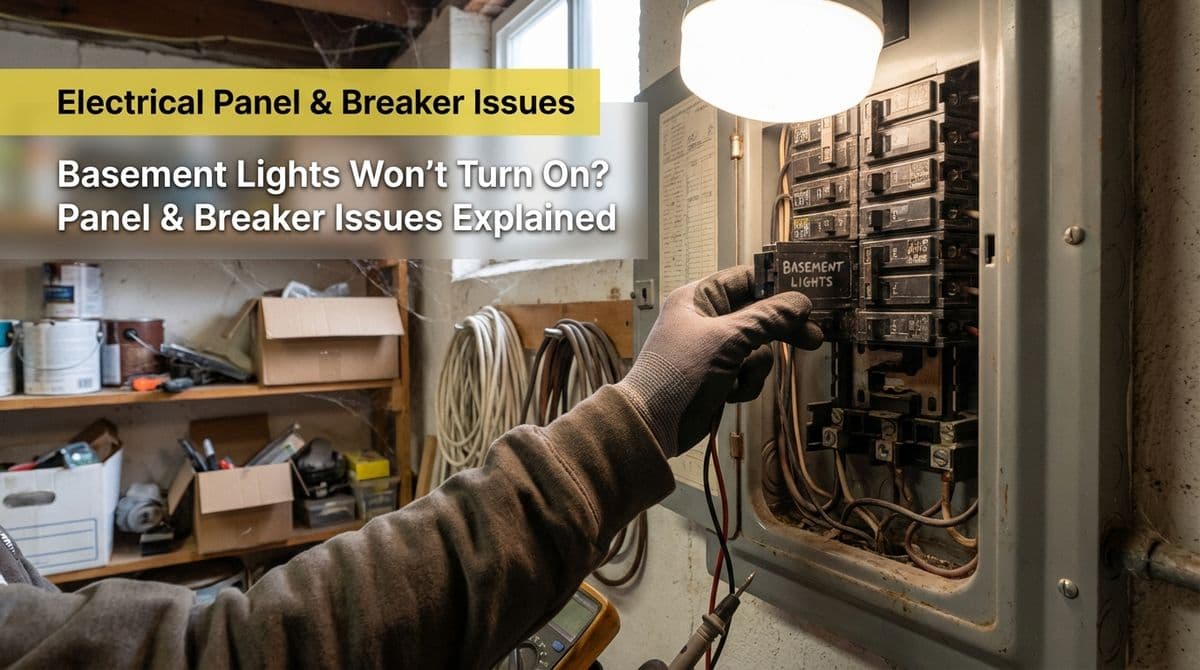
When Your Basement Suddenly Goes Dark
We recently got a call from a homeowner — let’s call him Mark — here in Buford. Mark was standing in his dark basement, a little frustrated and a little worried.
“I think one or two breakers have blown,” he told us. “The basement lights aren’t coming on, and I’ve gone down to the electrical panel, but I can’t seem to get it to work. I’m not an electrician, obviously.”
That’s a call we get a lot. A specific area of the home — like a basement, bonus room, or part of a kitchen — suddenly loses power, and the electrical panel doesn’t seem to fix it. Let’s walk through what we explained to Mark, and what we look for when your basement lights won’t turn on.
First Things First: Is It Really the Breaker?
Many homeowners assume, like Mark, that “a breaker is blown.” Sometimes that’s true, but often the situation is a little more nuanced.
Before you call an electrician, there are a few simple checks you can safely try:
- Check nearby lights and outlets: Is it just the basement lights, or are outlets and other rooms affected too? This helps narrow down which circuit might be involved.
- Look at the panel for an obviously tripped breaker: A tripped breaker will usually sit between ON and OFF, or feel a bit “spongy” compared to the others.
- Try a proper reset: Firmly push the suspected breaker all the way to OFF, then back to ON. Many people skip the “all the way off” part and the breaker never really resets.
If the breaker immediately trips again or won’t stay on, stop there. That’s a sign of a potential short, overload, or equipment problem that needs a professional.
Common Panel and Breaker Issues We Find in Basements
When we come out for a diagnosis — like we scheduled for Mark — we don’t just swap a breaker and hope for the best. We start with a systematic check of the panel and the affected circuit. Here are some of the most common issues we find when a basement goes dark:
- Overloaded circuits: Basements often share a circuit with freezers, dehumidifiers, space heaters, treadmills, or power tools. Too much plugged into one circuit can repeatedly trip a breaker.
- Loose connections in the panel: A loose neutral or hot wire on the breaker or bus bar can cause intermittent or complete loss of power to the entire basement lighting circuit.
- Failed breaker: Breakers do wear out. Age, heat, and repeated tripping can cause a breaker to stop functioning correctly, even if the wiring is fine.
- Moisture-related issues: Basements can be humid. Corrosion on connections or in junction boxes can create resistance and heat, leading to nuisance tripping or dead circuits.
- Damaged wiring: Renovations, finishing a basement, or even a poorly placed nail or screw can damage a cable hidden in a wall or ceiling.
Our job on a diagnosis visit is to pinpoint which of these is really causing the problem before we replace anything.
What We Do on a Basement Power Diagnosis Visit
On the phone with Mark, we explained that this kind of issue falls under our diagnosis and repair visit. In plain English, here’s what that typically includes when your basement lights won’t turn on:
- Panel inspection: We open the electrical panel, check for obvious signs of overheating, corrosion, mismatched breakers, or loose terminations.
- Test the suspect breakers: Using a meter, we verify whether the breaker is actually delivering proper voltage when in the ON position.
- Circuit tracing: If needed, we trace the affected circuit to see where power is lost — panel, junction box, switch, or fixture.
- Check switches and junction boxes in the basement: Sometimes the failure point isn’t in the panel but at a light switch, a splice, or the first light on the run.
- Recommend the right repair: That might be replacing a faulty breaker, tightening connections, repairing a damaged wire, or in some cases, redistributing loads onto separate circuits.
In Mark’s case, like many others, we scheduled a time window that worked for his family so we could come out, get eyes on the panel, and fix the problem while we were there if it was indeed a breaker issue.
When It’s Safe to Try Yourself — and When It’s Not
We always want homeowners to stay safe. There are a few things you can do without getting into dangerous territory, and a few you should leave strictly to a licensed electrician.
Reasonable DIY Checks
- Reset a clearly tripped breaker (OFF then ON).
- Unplug non-essential items on that circuit (like space heaters or tools) and try again.
- Check for burned-out bulbs or loose bulb connections at the fixtures.
Call a Pro Immediately If You Notice:
- Breakers that trip again immediately after you reset them.
- Visible burn marks, melted plastic, or a hot smell at the panel or switches.
- Buzzing, crackling, or sizzling sounds from the panel or fixtures.
- Flickering or partial power in multiple rooms, not just one circuit.
Removing the panel cover and working around live bus bars is not a DIY project. That’s where the risk of shock or arc fault becomes very real.
Preventing Future Basement Power Problems
Once we get your lights back on, we like to help you avoid the same call in a few months. Here are some steps we often recommend:
- Don’t overload one circuit: Spread out large loads like space heaters, freezers, and power tools onto different circuits when possible.
- Ask about a dedicated circuit: If your basement is finished or heavily used, it may deserve its own dedicated lighting and receptacle circuits.
- Consider an electrical panel checkup: Especially in older homes, a periodic inspection can catch loose connections or aging breakers before they fail.
- Upgrade if needed: If you’re constantly tripping breakers, that’s often a sign the home’s electrical system isn’t sized for how you actually live and use the space.
Basement Lights Out? We’re Here to Help
If you find yourself in Mark’s shoes — standing in a dark basement, staring at a panel that “should” work but doesn’t — you’re not alone. These are very common issues and, with the right diagnosis, usually very fixable.
We’re always happy to come out, track down the real cause, and get your basement lit and safe again. And if you’re not sure whether it’s worth a service call, you can always reach out and we’ll talk through what you’re seeing before we schedule anything.
Your basement doesn’t have to stay in the dark — and neither do you when it comes to understanding your electrical panel and breakers.