Breaker Keeps Tripping with Outdoor Fryer? Repair or Upgrade?
Breaker tripping when you use an outdoor fryer or appliance? Learn what it means, what’s safe to try, and when you really need a panel upgrade vs. a simple repair.
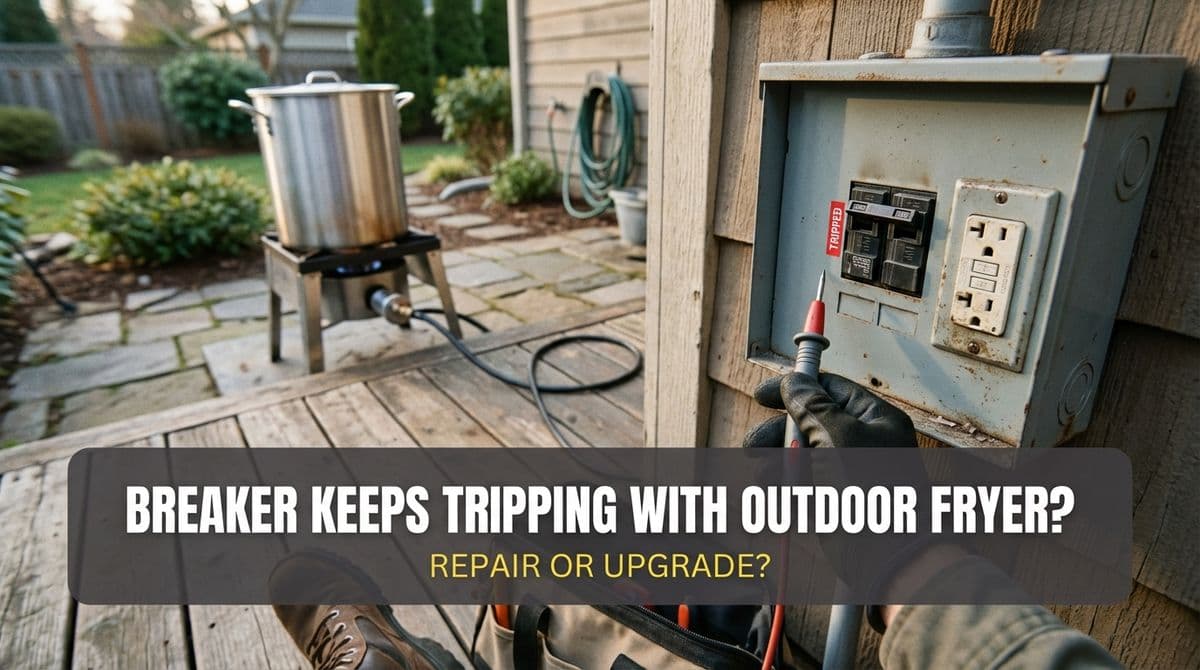
Why Your Breaker Trips When You Use Outdoor Appliances
We recently got a call from a homeowner — let’s call him Tom — who was frustrated with his “fuse box.” Every time he plugged in his outdoor fryer, the breaker would trip. His big question was simple: “Do I need a whole new panel, or is this just a repair?”
We hear some version of Tom’s situation a lot, especially around holidays, game days, and backyard get-togethers when people break out fryers, griddles, and other high-power outdoor appliances. If your breaker keeps tripping when you use something outside, you’re not alone — and it doesn’t always mean you need an expensive panel upgrade.
What Your Breaker Is Trying to Tell You
First, it helps to understand what the breaker is actually doing. A breaker trips for a few main reasons:
- Overload – Too many things drawing power on the same circuit.
- Short circuit – A hot wire touching neutral or ground, creating a high-current fault.
- Ground fault – Electricity leaking to ground, often through moisture or damaged wiring (what GFCI outlets are designed to catch).
In Tom’s case, every time he plugged in his outdoor fryer, the breaker snapped off almost immediately. That told us the circuit was likely either overloaded or the appliance/wiring was faulty. The breaker tripping is not the problem — it’s the safety feature that’s stopping a problem from turning into melted wires, burned insulation, or even a fire.
Why Outdoor Fryers and Appliances Trip Breakers
Many outdoor fryers, griddles, and heaters pull a lot of power — often 1,500–1,800 watts or more. If you’re plugging that appliance into a standard 15-amp circuit that already feeds indoor outlets, lights, or a garage fridge, you’re asking that circuit to do more than it was ever designed for.
On top of that, outdoor use introduces more variables:
- Moisture from rain, sprinklers, or morning dew getting into outlets, cords, or the fryer itself.
- Long extension cords that overheat or cause voltage drop, making the appliance work harder.
- Old or loose outdoor outlets that weren’t meant for heavy continuous loads.
Put all that together, and your breaker is doing exactly what it should: it’s saying, “Something’s not right here.”
Do You Need a Panel Upgrade or Just a Repair?
This is usually the part of the conversation where someone like Tom asks, “So… am I looking at a full panel upgrade?” The honest answer is: not always. A tripping breaker can mean a lot of different things. Here’s how we think through it when we come out for a diagnosis and repair.
When a Simple Repair Is Enough
Many times, we can solve the problem without touching the main panel, for example:
- Replacing a worn or damaged outdoor outlet that’s arcing or overheating.
- Fixing loose connections in the circuit that are causing heat and nuisance trips.
- Repairing or replacing a bad breaker that’s become overly sensitive with age.
- Moving loads to different circuits so your fryer isn’t sharing power with a freezer, lights, and half your kitchen.
In these cases, the cost stays in the “diagnose and repair” range, and we get your existing system working safely again without a major upgrade.
Signs You May Actually Need a Panel Upgrade
There are times when your electrical system is simply maxed out. We start to think about a panel upgrade when we see things like:
- Frequent tripping on several different breakers, not just one.
- No available breaker spaces in the panel to add a dedicated circuit for your outdoor appliances.
- Old or obsolete panels that are known safety issues or no longer meet code.
- Undersized service (for example, 100-amp service in a home full of modern high-demand appliances).
If we determine the panel is the bottleneck, then we’ll talk through upgrade options, costs, and how much flexibility and safety you’ll gain — like adding dedicated outdoor circuits for fryers, heaters, and other gear.
Safe Temporary Workarounds Before We Arrive
While you’re waiting for us to come out and take a look, there are a few safe things you can try — and a few things you should absolutely avoid.
What You Can Safely Try
- Unplug other items on the same circuit (garage fridge, lights, tools) before you run the fryer.
- Use the shortest, heaviest-duty extension cord you have, rated for outdoor use, if you must use a cord at all.
- Keep connections dry and off the ground. Use outlet covers and avoid puddles and wet grass.
- Test the fryer on a different circuit (in a different part of the house) to see if the issue follows the appliance or stays with the outlet.
What You Should Not Do
- Do not upsize the breaker (for example, changing a 15-amp breaker to 20-amp) without upgrading the wiring. That’s a fire hazard.
- Do not use cheap, undersized extension cords that get warm or hot to the touch.
- Do not tape the breaker on or keep resetting it rapidly. Repeated trips mean something is wrong.
- Do not bypass GFCI protection just to keep something from tripping. GFCI trips often mean a shock hazard.
If any breaker trips immediately when you plug in the fryer, or you see/smell anything unusual (smoke, burning smell, buzzing), stop using it and wait for a professional.
Questions We’ll Ask You on the Phone
When you call us, like Tom did, we’ll often ask a few quick questions so we can show up better prepared:
- What exactly is plugged in when the breaker trips? (Just the fryer, or other things too?)
- How long does it run before the breaker trips — instantly, a few seconds, or several minutes?
- Are you using an extension cord? If so, how long and what kind?
- Has this outlet or circuit worked fine in the past with the same appliance?
- Do other breakers trip around the house, or is it always the same one?
Your answers help us narrow down whether we’re likely dealing with an overloaded circuit, a failing breaker, a wiring issue, or a problem with the appliance itself. That way, when we arrive for the diagnosis and repair, we’re ready with the right parts and a solid game plan.
How Our Diagnosis and Repair Visit Works
For situations like Tom’s, we schedule a diagnosis and repair visit. Here’s what we typically do:
- Inspect the panel for obvious issues: heat damage, double-tapped breakers, corrosion, or outdated equipment.
- Check the outdoor outlet and wiring feeding that fryer (or other appliance) for damage or loose connections.
- Test the breaker under load to see if it’s performing within its rating or tripping too easily.
- Measure the actual load on the circuit while the appliance runs, so we know if it’s simply overloaded.
In many cases, we can fix the issue on the spot during that same visit. If we find that your panel truly needs to be upgraded, we’ll show you exactly why, walk you through your options, and provide clear pricing before any larger work is done.
Planning Ahead for Outdoor Cooking and Entertaining
If you love outdoor frying, grilling, or running heaters and lights on the patio, it may be worth adding a dedicated outdoor circuit. That way, your fryer isn’t fighting your garage freezer and half the basement for power.
We can help you:
- Install dedicated GFCI-protected circuits for outdoor cooking stations.
- Add weatherproof outlets in convenient locations.
- Evaluate whether your current panel can handle it or if an upgrade makes sense.
So if your breaker keeps tripping every time you plug in that outdoor fryer, don’t ignore it and don’t try dangerous workarounds. Give us a call, and we’ll help you figure out whether you’re looking at a simple repair, a new circuit, or a true panel upgrade — and we’ll make sure your backyard cooking is both fun and safe.