Why Your Ceiling Fan Needs a Proper Fan-Rated Box
Standard light boxes aren’t designed for moving ceiling fans. Learn why a proper fan-rated box matters for safety, noise, and code compliance in your home.
The Call That Sparked This Conversation
We recently got a call from a customer — let’s call her Nicole — who wanted us to come out and install a proper mounting box for the ceiling fan in her daughter’s room.
She already had a fan installed and planned to keep the same one. What she really wanted was for us to “get it boxed in and stabilized” the right way. As we talked, we realized she was dealing with a situation we see all the time: a ceiling fan hanging from a standard light box instead of a fan-rated box.
On Nicole’s call, we told her something we end up explaining to a lot of homeowners: a regular 15-pound light box is not safe for a ceiling fan. For a fan, you need a box rated for at least 70–75 pounds and designed for movement.
Why a Regular Light Box Isn’t Good Enough
During our conversation with Nicole, we walked her through the difference between a normal light box and a fan-rated box. It helped her feel more confident about why she was doing the right thing by calling us out.
Here’s what we explained to her:
- Standard light boxes are usually rated for around 15 pounds and are meant for fixtures that don’t move: basic domes, small chandeliers, flush-mount lights, etc.
- Ceiling fans move constantly, vibrate, and sometimes get pulled on (kids, pets, or just hitting the pull chains). That motion puts stress and torque on the box and the framing above.
So even if your fan isn’t extremely heavy, the motion and vibration are what a regular light box simply isn’t designed to handle. Over time, screws can loosen, plastic can crack, and the box can pull away from the ceiling.
What Makes a Fan-Rated Box Different?
On Nicole’s call, we told her that by code and by good practice, a fan should be mounted to a box that’s actually listed and labeled for ceiling fan support. Here’s what that usually means:
- Higher weight rating – Most fan-rated boxes are rated for 70–75 pounds (or more), not just 15 pounds like a standard light box.
- Stronger materials – Often metal or heavy-duty plastic designed to handle both weight and movement.
- Better mounting – The box is either fastened directly to a framing member (joist) or to a fan-rated brace bar that spans between joists.
- Marked for fan support – Legitimate boxes are labeled for “ceiling fan support” so there’s no guesswork.
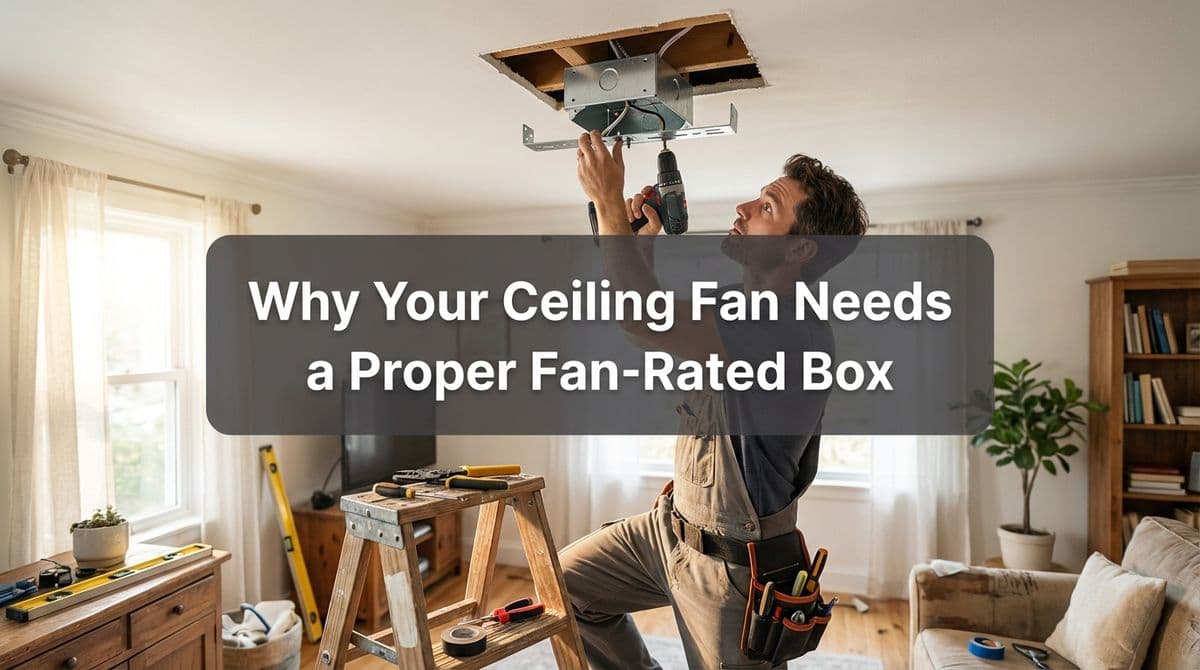
We told Nicole that when we come out, our plan was simple: remove the existing box, install a proper fan-rated box, then reassemble and re-hang her existing fan. That way her daughter’s room would be safer without needing a new fan.
Real Risks of Using the Wrong Box
Even though Nicole’s fan hadn’t fallen, she had the right instinct: “The important thing is just getting it fixed the right way.” We agreed with her 100% and explained why we take this seriously.
Here are the main risks we shared with her:
- Wobbling and noise – An under-rated box can flex or loosen, making the fan wobble, hum, or rattle, even if the blades are balanced.
- Fan coming loose – Over time, vibration can work screws loose. In the worst cases, fans have pulled free from the ceiling.
- Electrical hazards – If a box moves, it can stress the wiring connections, increasing the chance of loose connections, arcing, or shorts.
- Code and insurance issues – Many areas require fan-rated boxes by code. If there’s ever damage, an improper installation could raise questions with insurance.
We told Nicole that a lot of these problems started when unlicensed folks or new “pandemic-era” businesses began hanging ceiling fans on whatever box happened to be there. It might look fine at first, but the risk builds over time.
How We Safely Upgrade a Fan Box
Nicole already had a fan in place, so she asked if we could just “come over and do it” without replacing the fan itself. We told her that’s exactly what we do all the time.
Our typical process looks like this:
- Turn off power at the breaker and verify the circuit is dead.
- Remove the fan carefully, supporting the motor so there’s no strain on the wiring.
- Take out the existing box (usually a light-duty plastic or metal box not rated for fans).
- Install a fan-rated box, either directly to the joist or with an adjustable brace bar rated for fan support.
- Secure wiring connections inside the new box, following code and manufacturer instructions.
- Re-hang and reassemble the fan, then test for wobble, noise, and proper operation.
That’s essentially what we planned for Nicole’s daughter’s room: a straightforward box swap and re-install that gives her peace of mind.
How to Tell If Your Fan Has the Right Box
On the phone, Nicole wasn’t sure who had installed the fan originally. If you’re in the same boat, here’s what we usually tell homeowners:
- Check age and history – If a DIYer, handyman, or “friend of a friend” installed the fan, there’s a good chance they reused a light box.
- Look at the mounting – With the power off, you can sometimes drop the canopy (the cover at the ceiling) and see the box. A flimsy plastic box or one that’s only nailed through drywall, not into framing, is a red flag.
- Look for markings – Fan-rated boxes are usually labeled or stamped for ceiling fan support and have a higher weight rating.
If you’re not comfortable checking this yourself, that’s exactly what we come out to look at. With Nicole, we set up an afternoon time that worked around her schedule, then we planned to verify the box and upgrade it if needed.
When in Doubt, Upgrade the Box
We told Nicole something we’ll say to you as well: if there’s any doubt about what’s holding your ceiling fan up, it’s worth having it checked. A fan-rated box is a relatively small investment compared to the potential damage from a falling fan or long-term electrical issues.
If you suspect your fan might be hanging from a standard light box — or you just want the peace of mind Nicole was looking for — reach out and we’ll be glad to take a look, explain what you have, and make sure it’s done the right way.