Is Your Electrical Panel Keeping Up With Your HVAC?
Wondering if your old electrical panel can safely handle your HVAC? Learn how breaker sizes, circuit loads, and even dead ceiling fans can reveal hidden issues.
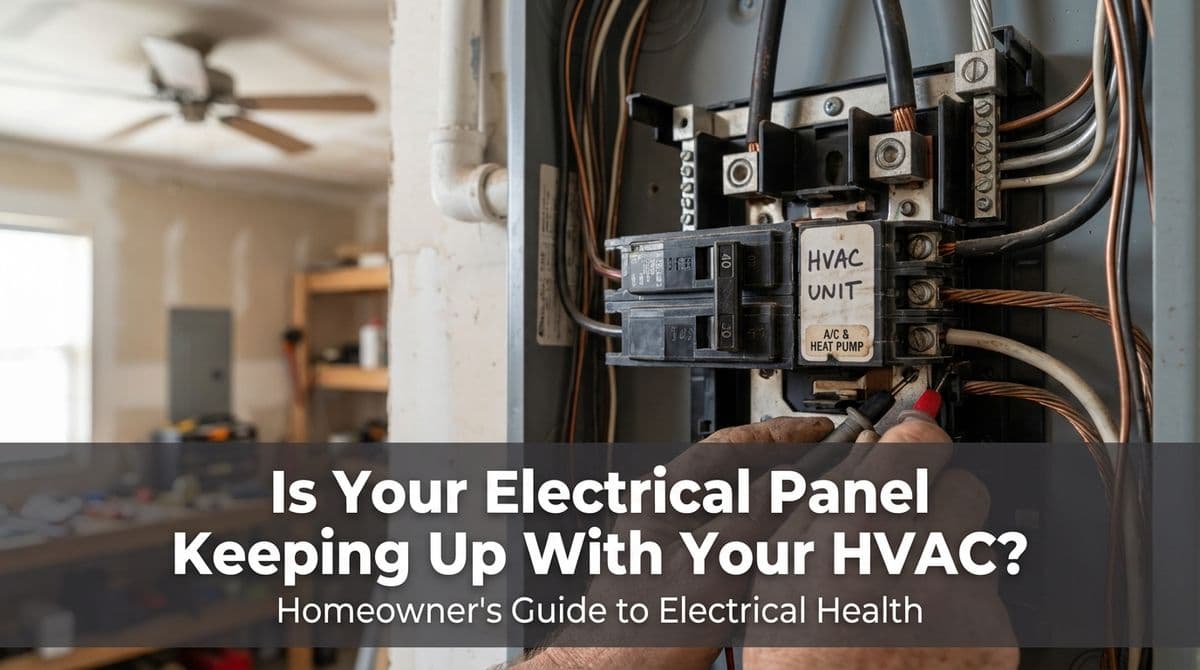
When Your HVAC and Electrical Panel Don’t Match
We recently got a call from a homeowner — we’ll call her Linda — who was feeling pretty overwhelmed. She told us her electrical panel was original to the house, the previous owner had installed a new HVAC system, and someone had mentioned something about “20 amp vs 40 amp” that didn’t sound right. On top of that, she had two ceiling fans that just wouldn’t turn on.
Linda’s main question was simple: “Is my electrical panel actually keeping up with my HVAC, and is everything wired safely?” That’s a smart question to ask, especially in older homes or when equipment has been upgraded over the years.
We’ll walk you through the same things we explained to her: how to tell if your electrical panel is up to the job, what breaker sizes mean, common HVAC–panel mismatches, what non-working ceiling fans can hint at, and when it’s time to have us (or another licensed electrician) take a closer look.
How Old Is Your Electrical Panel, Really?
Linda’s panel was original to the house, which meant it was up to code when it was installed — but codes and electrical demands change over time. Modern HVAC systems, larger appliances, and added outlets all put more load on a home’s electrical system than it was designed for decades ago.
Here are a few signs your panel might be outdated or undersized:
- It’s over 30–40 years old and has never been upgraded.
- There’s no room for more breakers and you see multiple double-tapped breakers (two wires under one screw).
- Brand or style is known to be unsafe (for example, certain older panels that electricians often recommend replacing).
- Frequent tripping when HVAC, oven, and other big loads run together.
We always remind homeowners: just because an old panel is still working doesn’t mean it’s handling today’s load safely or efficiently.
Breaker Sizes 101: 20 Amp vs 40 Amp and More
Linda had been told something about her HVAC being on the “wrong” breaker size — someone mentioned 20 amp when it should be 40 amp. That’s a big red flag worth checking.
Every major appliance has a nameplate on it (usually on the outside or behind an access panel) that lists the required circuit size. For HVAC equipment, we look for wording like “Minimum Circuit Ampacity (MCA)” and “Maximum Overcurrent Protection.”
In general:
- 20 amp breakers are common for general-purpose circuits (outlets, lights) and some smaller equipment.
- 30–40+ amp breakers are typical for larger loads like central AC condensers, heat pumps, electric furnaces, and some air handlers.
If your HVAC is supposed to be on a 40 amp circuit but it’s tied to a 20 amp breaker, that’s an undersized circuit. The breaker may trip frequently — which is annoying, but also a safety feature doing its job. On the other hand, if someone installed a larger breaker than the wiring or equipment is rated for, that can allow wires to overheat without tripping, which is much more dangerous.
Common HVAC–Panel Mismatches We See
When we come out to a home like Linda’s, here are a few of the HVAC-related issues we often find:
- Wrong breaker size (too big or too small for the HVAC unit and wiring).
- Shared circuits, where an HVAC unit is on the same breaker as outlets or lights — not allowed for most systems.
- Old aluminum wiring or splices feeding HVAC equipment that was added later.
- No dedicated disconnect near the outdoor unit, making service and emergency shutoff harder.
- Panels maxed out, with no safe space to add the correct breakers for new HVAC equipment.
Any of these can mean the system isn’t just inconvenient — it may also be a safety and reliability issue.
Warning Signs Your Circuits May Be Undersized
Linda’s concern about “not having enough power” is something we hear a lot. While we need to test and inspect to know for sure, there are some warning signs homeowners can watch for:
- Frequent breaker trips when the AC or heat kicks on.
- Lights dimming or flickering when HVAC starts or runs.
- Warm breaker panel cover (not just slightly warm, but noticeably hot in spots).
- Buzzing or crackling sounds from the panel or disconnects.
- Burning or “hot metal” smells near electrical equipment.
If you notice any of those, we recommend turning off the suspect breaker and calling a licensed electrician promptly.
What Non-Working Ceiling Fans Can Tell You
Because we were already coming to check Linda’s panel and HVAC circuit, she asked us to look at two ceiling fans that weren’t working. That’s actually a smart move: small problems can reveal bigger issues.
When we troubleshoot non-working fans, we often find:
- Loose connections in fan boxes or at wall switches.
- Improper fan-rated boxes (regular boxes used where fan-rated ones are required).
- Overloaded lighting circuits that feed multiple rooms and fans.
- Old wiring with brittle insulation that’s failing under load.
If several fans or lights on the same circuit have issues, that can hint at a broader wiring or panel problem, not just a bad fan motor. That’s why we like to look at the entire circuit, not just the fixture.
Safety Do’s and Don’ts Around Your Panel
While we encourage homeowners to pay attention to their electrical system, there are clear limits to what should be DIY. Here are a few safety tips we share when we’re on-site:
Do:
- Keep the area clear around your panel so it’s easy to access in an emergency.
- Label breakers so you know what each one controls.
- Visually inspect for rust, moisture, scorch marks, or missing panel covers.
- Turn off a breaker if you hear buzzing or smell burning, then call an electrician.
Don’t:
- Remove the panel cover or touch internal wiring if you’re not trained.
- Upsize a breaker “just to stop it from tripping.” That can create a fire hazard.
- Use extension cords as a substitute for permanent wiring for HVAC or major appliances.
- Ignore repeated trips from the AC or heat — that’s a signal, not just an inconvenience.
When to Call an Electrician for an Inspection or Upgrade
With Linda, the right first step was an on-site estimate. We inspected her panel, checked the breaker size and wiring for her HVAC, and tested the ceiling fan circuits. Sometimes we find that everything can be corrected with a few wiring changes; other times, a panel upgrade is the safest long-term solution.
You should consider calling us (or a qualified local electrician) if:
- Your panel is original to an older home and you’ve added new HVAC or major appliances.
- You’re unsure whether your HVAC is on the correct breaker size or dedicated circuit.
- You’re experiencing tripping, dimming lights, or odd noises from the panel.
- Multiple fans, lights, or outlets on the same circuit aren’t working reliably.
When we visit, you can ask questions like:
- “Is my HVAC on the right size breaker and wire?”
- “Does my panel have enough capacity for what we’re running now?”
- “Are there any safety issues you’d fix right away if this were your home?”
- “If we need a panel upgrade, what are my options and timelines?”
Our goal is always the same: make sure your HVAC and electrical panel are working together safely, efficiently, and reliably — so you can stay comfortable without worrying what’s happening behind that metal door in the hallway or garage.