Why Your Garage Fridge Keeps Tripping a GFCI Outlet
Garage fridge keeps tripping the GFCI outlet? Learn why it happens, what you can safely check yourself, and when it’s time to call an electrician.
Why Your Garage Refrigerator Keeps Tripping a GFCI
We recently got a call from a customer — let’s call him Mark — who was frustrated with a brand-new problem in his garage. He told us, “We’ve had a refrigerator in the garage for 20 years with no issues. The old one died, I brought in another fridge, and now it keeps tripping the GFI outlet.”
Mark had done what most of us would do: unplug, reset, plug back in, repeat. Each time, the GFCI (or GFI) outlet would run the refrigerator for a bit and then trip again. He was worried something was wrong with the fridge, the outlet, or the wiring — and he wasn’t sure what to do next.
If that sounds familiar, you’re not alone. Garage refrigerators and GFCI outlets don’t always play nicely together. Let’s walk through why it happens and what you can safely do about it.
First Things First: What Is a GFCI and Why Is It There?
A GFCI (Ground-Fault Circuit Interrupter) outlet is designed to protect you from electrical shock. It constantly monitors the current going out and coming back. If it senses even a small imbalance — like electricity leaking to ground through moisture, a damaged cord, or a person — it trips off in a fraction of a second.
That’s why you’ll typically find GFCIs in wet or potentially damp locations:
- Garages
- Basements
- Kitchens and bathrooms
- Outdoor outlets
In most areas, current electrical codes require garage outlets to be GFCI-protected. So if your garage fridge is on a GFCI, that’s usually code-compliant and done for safety.
Why Your Old Garage Fridge Worked Fine (and the New One Doesn’t)
This was Mark’s biggest question: “Why did my old garage refrigerator work for 20 years on this outlet, and this new one trips it?” It feels like the outlet is suddenly the problem, but that’s not always the case.
Here are a few common reasons a replacement fridge starts tripping a GFCI that an older unit never bothered:
- Different compressor or start-up characteristics: Some modern refrigerators draw a sharp inrush of current when the compressor kicks on. That surge can cause a sensitive GFCI to trip.
- More electronics inside: Newer units often have control boards, ice makers, digital displays, and defrost systems that can introduce tiny leakage currents — sometimes enough to bother the GFCI.
- Actual ground fault in the fridge: It’s not uncommon for a used or inexpensive fridge to have a compromised component (like a compressor winding or defrost heater) that leaks to ground. A standard outlet might still run it; a GFCI will shut it down.
- Environmental factors: Garages get hot, cold, and humid. Condensation on wiring or components in the fridge or at the outlet can push a borderline situation over the edge.
So the fact that the old fridge “never had a problem” doesn’t guarantee the wiring or outlet are perfect — it just means the previous combination never pushed the GFCI hard enough to trip.
Basic Checks You Can Safely Do Yourself
When we talked with Mark, we walked him through a few simple, non-invasive checks before scheduling a visit. You can do the same:
1. Rule Out a Simple Outlet or GFCI Issue
- Test the GFCI: Press the “TEST” button — it should click off. Press “RESET” — it should click back on and supply power.
- Try another device: Plug in a simple load (like a lamp or small power tool). If that trips the GFCI immediately, the outlet or circuit may be the problem, not the fridge.
- Look for signs of damage: Check for burn marks, melted plastic, or a loose, wobbly receptacle. If you see any of that, stop and call an electrician.
2. Inspect the Refrigerator Cord and Placement
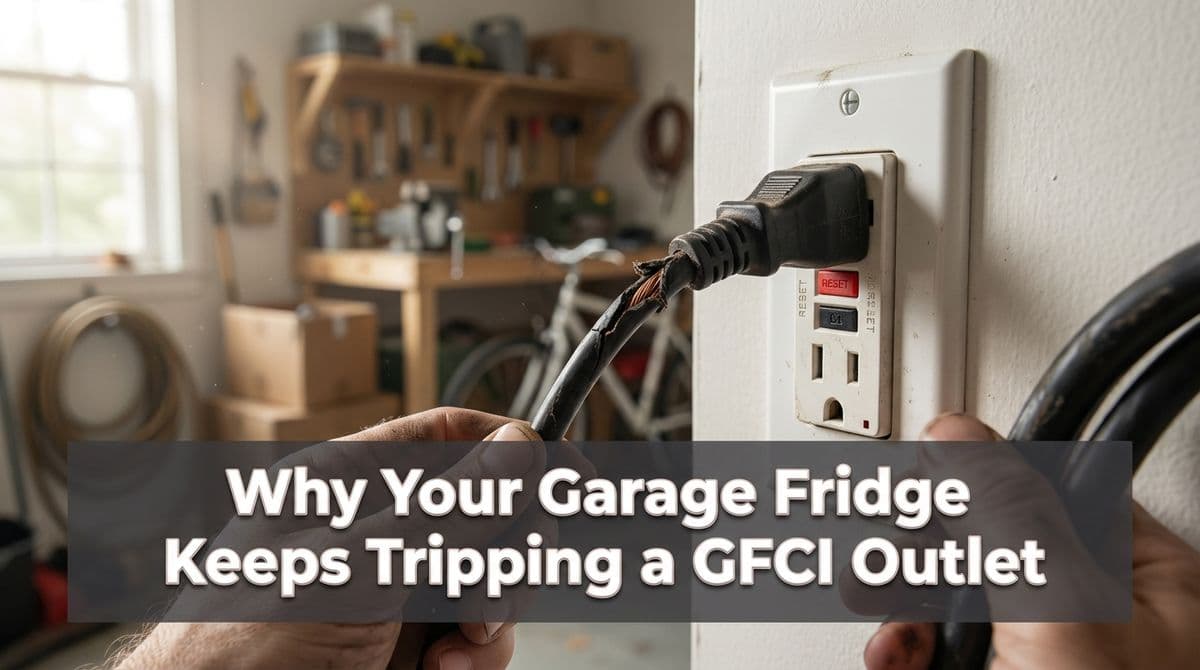
- Check the cord: Look for cuts, kinks, crushed spots, or exposed wires on the fridge cord. A damaged cord can absolutely trip a GFCI.
- Avoid extension cords: Long, undersized, or damaged extension cords can cause nuisance trips and are unsafe for refrigerators.
- Give it breathing room: Make sure the fridge isn’t jammed tight against the wall, pinching the cord or overheating the compressor.
If all that looks good but the GFCI still trips mainly when the compressor kicks on, it’s time for a deeper look.
When You Definitely Need a Professional
On Mark’s call, once we heard he’d had a fridge in that spot for decades, but this unit was consistently tripping the GFCI, we knew it could be one of two things: a sensitive or failing GFCI, or an issue in the refrigerator itself (like insulation breakdown in the compressor or a defrost heater fault).
You should bring in a licensed electrician (and sometimes an appliance tech) if:
- The GFCI trips repeatedly even after you’ve tried a different outlet or replaced the GFCI.
- Other outlets or lights on the same circuit flicker or lose power.
- You notice burning smells, buzzing, or heat at the outlet or breaker.
- The breaker itself is tripping along with the GFCI.
We use testers and meters to check for actual ground faults, insulation resistance, and overloading on the circuit, and we can tell you whether the problem is the fridge, the outlet, or the wiring feeding it.
Is It Okay to Put a Garage Fridge on a Non-GFCI Outlet?
This is the part no one likes to hear, but it’s important: simply moving the refrigerator to a non-GFCI outlet or replacing a GFCI with a standard receptacle in a location that’s required to be GFCI-protected is not only unsafe — it can also put your home out of code.
There are some code-compliant ways we sometimes address nuisance tripping:
- Dedicated circuit for the refrigerator (still GFCI-protected, but not shared with tools or other loads)
- Replacing an overly sensitive or aging GFCI with a new, properly rated one
- Correcting wiring issues like shared neutrals, loose connections, or moisture problems
But the solution should never be to remove shock protection where the electrical code says it belongs.
What We Did for Our Customer
With Mark, we scheduled a quick visit — it was on the way home for one of our techs — to test both the circuit and the refrigerator. In cases like his, we typically:
- Test the GFCI’s trip threshold and replace it if it’s weak or overly sensitive
- Check the circuit wiring and connections for loose neutrals or signs of moisture
- Measure the refrigerator’s leakage current and compressor inrush
- Confirm whether the fridge itself has a fault that needs an appliance technician
Sometimes the fix is as simple as installing a new GFCI and tightening a few connections. Other times, we have to break the news that the “new” garage fridge has internal issues.
Need Help with a Tripping Garage Outlet?
If your garage refrigerator keeps tripping a GFCI outlet, don’t ignore it and don’t just bypass the protection. There’s a reason it’s shutting off — and we can help you figure out whether it’s a nuisance trip or a real safety problem.
We troubleshoot these kinds of issues all the time. If you’re tired of resetting that outlet every few days, reach out and we’ll take a look, just like we did for Mark.