Why Half Your Kitchen Outlets Suddenly Stopped Working
Half your kitchen outlets stopped working but the breaker looks fine? Learn common causes, safe checks you can do, and when it’s time to call an electrician.
A Weekend Call About a Half-Dead Kitchen
We recently got a call from a homeowner — we’ll call her Nicole — who told us, “Part of my kitchen went out over the weekend, and my husband has maxed out his electrical knowledge.” Half the outlets on her counters were dead, a few still worked, and they couldn’t figure out why.
If that sounds familiar, you’re not alone. We see this kind of kitchen issue a lot, and it can be frustrating because nothing looks obviously wrong — no burned outlets, no tripped breaker you can clearly see, just dead plugs.
Using Nicole’s situation as a real-world example, we want to walk through the most common causes, what you can safely check yourself, and when it’s time to stop troubleshooting and call a licensed electrician.
Why Half Your Kitchen Outlets Might Stop Working
1. A Tripped GFCI You Didn’t Notice
In most kitchens, at least one outlet is a GFCI (ground-fault circuit interrupter) — the one with the little RESET and TEST buttons. What many homeowners don’t realize is that a single GFCI can protect several outlets “downstream.” If that GFCI trips, the regular outlets fed from it lose power too.
With Nicole, we suspected right away that a GFCI might be involved, because only part of the kitchen was affected. Often, the dead outlets are all on one side of the sink or along one wall, while the others still work normally.
What you can safely check:
- Look for any outlets in the kitchen, pantry, nearby hallway, or even in the garage that have RESET/TEST buttons.
- Press RESET firmly once. If it clicks and power comes back, that was likely the issue.
- If it immediately trips again, stop there and call an electrician — that could mean a wiring problem or a faulty appliance.
2. A Breaker That Looks “On” but Is Actually Tripped
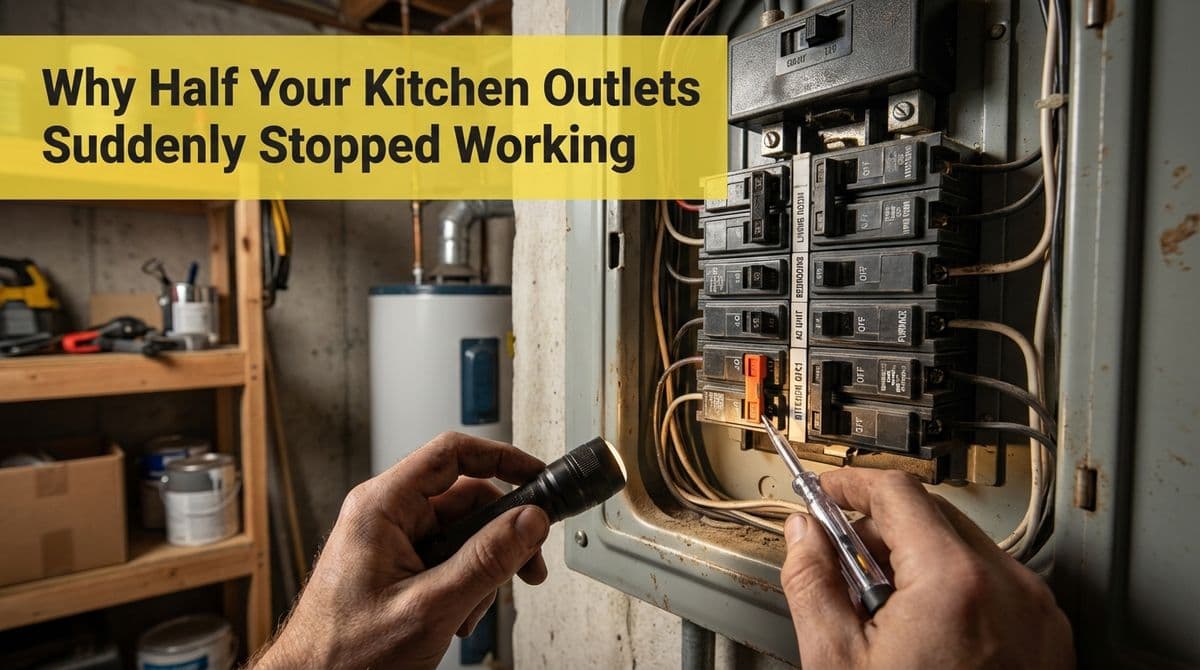
Another common cause is a partially tripped breaker. In the panel, the breaker handle might still look like it’s in the ON position, but internally it has tripped. We hear this a lot on calls like Nicole’s: “We checked the panel and everything looks fine.”
How to safely check your breakers:
- Stand on a dry surface, use a flashlight if needed, and open your panel door.
- Find the breakers labeled “Kitchen,” “Counter,” or “Small appliance.”
- Firmly switch each suspect breaker fully OFF, then back to ON.
- If a breaker will not reset or trips again right away, call an electrician. Do not force it or keep trying.
If cycling the breakers and checking GFCIs doesn’t restore power, there is likely a deeper issue in the wiring or devices.
Other Common Electrical Causes We See
3. Overloaded Circuits from Too Many Appliances
Kitchen circuits work hard. On calls like Nicole’s, we often learn that several high-draw appliances were running right before the outlets went dead — think toaster, coffee maker, air fryer, and microwave all at once.
Each small-appliance circuit is usually 20 amps. A couple of big appliances together can push that limit, trip the breaker or GFCI, and leave half the kitchen dark.
Practical tip: If you notice breakers or GFCIs tripping often when you cook, that’s a sign your kitchen may need additional circuits or a reconfiguration, not just a reset.
4. Loose Connections at One “Problem” Outlet
Sometimes, all the dead outlets are wired in a chain, and one bad connection in the first outlet of that chain can knock out power to everything downstream. Nothing will look wrong from the front — but behind the cover, wires can loosen over time from heat and use.
This is not something we recommend homeowners open up on their own. On a service visit, we’ll usually:
- Identify the first device in the run that still has power.
- Check the next outlet in line for loose connections, back-stabbed wires, or signs of heat damage.
- Re-terminate conductors properly and replace any damaged devices.
5. Aging or Damaged Wiring in Older Homes
In older North Georgia homes, kitchen circuits are sometimes a mix of original wiring and newer add-ons. Splices in junction boxes over cabinets, in crawl spaces, or behind backsplashes can fail over time. We occasionally find DIY work from years ago that was never quite up to code.
If your home is older, or you’ve had repeated kitchen electrical issues, it may be worth a more thorough inspection instead of just a quick fix on one outlet.
Safety First: What You Should Not Do
When half the kitchen goes out, it’s tempting to start unscrewing outlets and switching wires around. For your safety, we strongly recommend avoiding the following:
- Don’t work on live circuits. If you’re not 100% sure a circuit is off, leave it alone.
- Don’t replace breakers with larger sizes to “solve” tripping — that can create a fire hazard.
- Don’t use extension cords or power strips as a permanent workaround for dead outlets.
- Don’t ignore outlets that are warm, buzzing, or have a burning smell — call immediately.
Simple Preventive Tips for a Happier Kitchen Circuit
We always like to leave homeowners with ideas to reduce future problems. Here are a few easy habits that go a long way:
- Stagger appliance use: Try not to run multiple high-wattage appliances on the same counter at the exact same time.
- Know your GFCI locations: Make a mental note (or quick phone snapshot) of every GFCI in your kitchen, garage, and exterior so you can check them quickly if something trips.
- Watch for repeated trips: If a breaker or GFCI trips more than once or twice a month, have it inspected — that’s a warning sign, not “just one of those things.”
- Plan ahead for remodels: If you’re adding bigger appliances or more countertop gadgets, consider adding dedicated circuits instead of cramming more onto existing ones.
When to Call an Electrician (Like We Did for Nicole)
For Nicole, once we had her scheduled, our technician came out, tested the circuits, traced which outlets were on which breaker, and pinpointed the fault. In her case, the issue wasn’t visible from the panel or the front of the outlets — it required proper tools and training to find and fix safely.
You should call a licensed electrician if:
- Resetting GFCIs and breakers does not restore power.
- A breaker or GFCI will not reset or trips again immediately.
- You notice burning smells, scorch marks, buzzing, or warm outlets.
- You’re uncomfortable working around electrical panels or wiring (which is perfectly understandable).
If half your kitchen outlets suddenly stop working, we’re happy to help you troubleshoot the basics over the phone and, when needed, send a technician to diagnose and repair the problem safely and up to code.