Why Your Boat Keeps Tripping the New Marina GFCI
New marina dock tripping your houseboat’s GFCI? We explain what changed, why your boat is suddenly the “problem,” and what we check and fix to keep you safe.
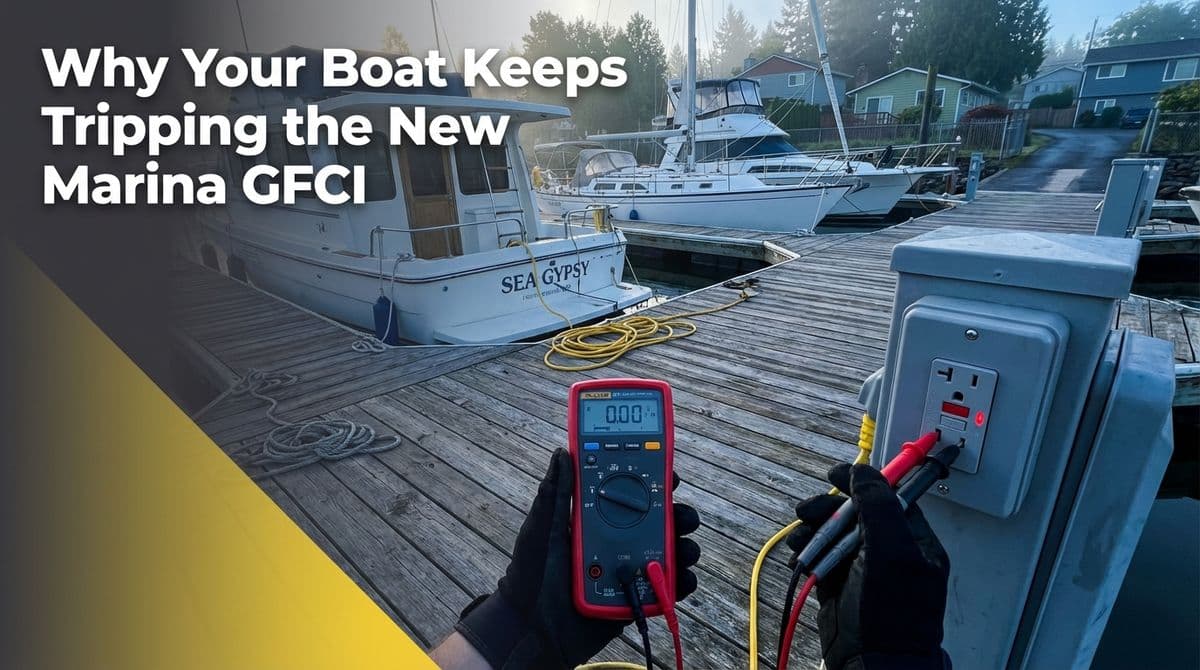
We recently got a call from a houseboat owner — let’s call him Jason — who keeps his boat at a newly rewired dock on Lake Lanier. The marina had just upgraded all the electrical with new GFCI protection, and as soon as they plugged Jason’s houseboat into shore power, the dock breaker tripped and his boat went dark. The dock crew told him, “You probably have a ground issue on the boat. Call an electrician who works on houseboats.” That’s how he ended up on our schedule.
We see this exact situation more and more as marinas upgrade to newer electrical codes. From our side of the toolbox, it’s a mix of safety improvements, changing standards, and older boat wiring that just doesn’t play nicely with new equipment.
What Changed on Docks and Marinas?
When we walk onto a newly rewired dock, we almost always see the same big changes:
- GFCI protection on the dock receptacles feeding each boat
- Stricter grounding and bonding requirements under newer electrical codes
- More sensitive protection devices that trip much quicker than old breakers
The idea behind all of this is simple: reduce the risk of electric shock drowning and fires around the water. As electricians, we’re fully on board with that goal. But from what we see, these upgrades also expose wiring issues that have been hiding on houseboats and RV-style boats for years.
On older houseboats, it wasn’t unusual to see things like:
- “Common ground” setups that no longer meet today’s standards
- Neutral and ground connected together in subpanels on the boat
- DIY repairs, add‑on breakers, or mystery junction boxes over the years
Those old practices might have worked fine on the previous dock with basic breakers. But once the marina installs modern GFCI and other protective devices, the dock will start tripping the moment it senses even a small leakage current from your boat.
Why Your Boat Trips the New Dock GFCI
When we get called to a dock like Jason’s, the pattern is usually the same: plug in the shore power, and either nothing comes on or the breaker pops instantly. The marina says, “It’s your boat,” and the boat owner says, “It worked fine last year.” Both can be right.
How GFCI Protection Sees Your Boat
GFCI (Ground-Fault Circuit Interrupter) devices constantly compare the current going out on the hot wire to the current returning on the neutral. If even a small amount “leaks” somewhere else — often to ground or into the water — the device trips to protect people from shock.
On houseboats we inspect, the common culprits we find include:
- Neutral and ground tied together somewhere on the boat
- Worn or damaged shore power cords allowing moisture and leakage
- Appliances or outlets with internal faults passing current to the chassis or ground
- Old panels wired to older standards that don’t cooperate with modern docks
From our perspective, the new GFCI equipment is just doing its job: it’s revealing a problem that was always there, even if the old dock never complained about it.
What We Check When a Houseboat Trips the Dock Breaker
When we pull up to a dock call like Jason’s, we follow a step‑by‑step process so we don’t miss anything. We’re not just trying to “make it stop tripping”; we’re making sure the whole system is safe for you, your family, and your neighbors.
1. Start at the Dock Connection
We begin right where your boat meets the marina:
- Inspect the dock pedestal and verify correct voltage and polarity
- Check that the GFCI or ELCI devices are working as designed
- Test with our own equipment before we even plug in your boat
If the dock checks out, we shift our focus fully to the boat side.
2. Shore Power Cord and Inlet
From what we see, shore power cords take a lot of abuse: sun, water, being stepped on, dragged, and coiled wet. We carefully look for:
- Burn marks or discoloration on the plugs
- Cracked, soft, or swollen insulation along the cord
- Loose or corroded blades on the plug and inlet
Sometimes, just swapping a damaged cord or repairing a corroded inlet is enough to stop nuisance tripping.
3. Main Panel and Grounding on the Boat
Next, we open up the main panel and start checking the internal wiring. On many houseboats we service, we find:
- Neutrals and grounds landed on the same bar in a subpanel
- Multiple panels added over the years without proper bonding
- Non‑marine breakers or components that aren’t ideal in that environment
We verify that neutral and ground are separated properly on the boat, and that bonding is handled the way current codes and marine standards expect.
How We Track Down the Exact Problem
Once we’ve done a visual and basic electrical check, we start testing methodically. This is where our meters and experience really matter.
Isolating Circuits Step by Step
We’ll often do this in front of the owner so they can see the process:
- Turn all boat breakers off.
- Plug into shore power and confirm whether the dock GFCI holds.
- Turn on one breaker at a time and watch for the trip.
When one particular circuit causes the dock to trip, that’s our clue. From there, we narrow it down further — for example, unplugging specific appliances, checking outlets, or inspecting a water heater or air conditioner.
Testing for Leakage and Faults
Behind the scenes, we’re also using specialized testers and meters to:
- Measure leakage current on neutral and ground conductors
- Verify correct polarity and wiring on each circuit
- Check continuity of grounding and bonding systems
Sometimes the fix is as simple as rewiring a mis‑landed neutral. Other times, we’re replacing an old panel or correcting years of piecemeal add‑ons so the boat plays nicely with modern dock protection.
What Boat Owners Can Safely Check Before Calling Us
While you can’t do the technical testing without the right tools (and training), there are a few simple things you can safely check before you call us out to the dock:
- Look at your shore power cord for cracks, soft spots, burn marks, or green corrosion on the plug blades.
- Check for moisture inside the cord ends or inlet; if it’s wet, disconnect and let it dry fully.
- Unplug nonessential appliances (portable heaters, older refrigerators, etc.) and see if the problem improves when you reconnect at the dock.
- Note exactly when it trips — immediately when you plug in, or only when a certain breaker or appliance comes on. That helps us zero in faster.
If anything looks burned, melted, or heavily corroded, we recommend you leave it unplugged and let us handle it. From our experience, those are early warning signs of bigger issues.
When to Call a Professional Electrician
If your newly rewired marina dock keeps tripping every time you plug in your houseboat, that’s not something to ignore or “work around.” We always remind customers that the dock protection is there to keep people from being shocked in the water.
You should reach out to an electrician who’s familiar with houseboats and dock power if:
- The dock GFCI or breaker trips every time you plug in
- It only stays on if the marina bypasses or swaps breakers (a red flag)
- You’ve noticed lights dimming, flickering, or buzzing on the boat
- Your boat has older panels or extensive DIY wiring
When we come out, our goal is to get you back to enjoying your time on the water with a system that’s both code‑compliant and safe on those upgraded docks. If your boat is suddenly “the problem” after a marina electrical upgrade, it doesn’t mean you did anything wrong — it usually just means it’s time to bring your boat’s wiring up to today’s standards.